
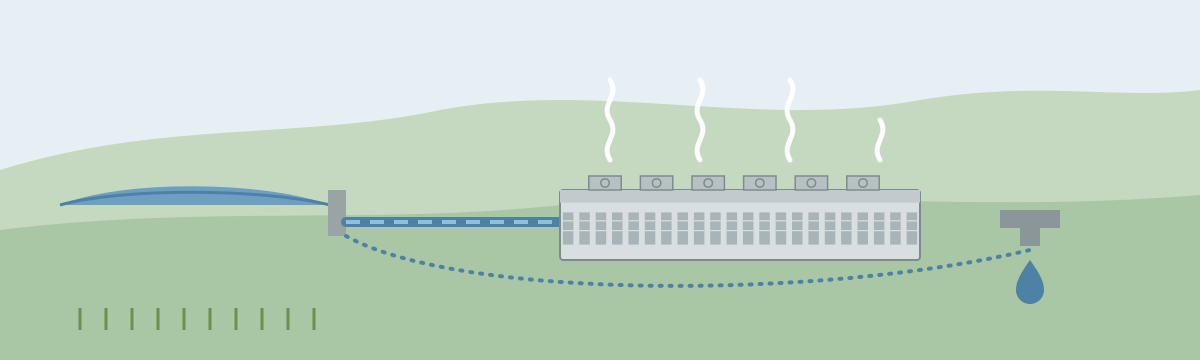
In brief
- How much water a data centre uses depends mainly on how it is cooled — and cooling is chosen at the design stage, usually before the public is consulted.
- The main industry survey of water use in England was voluntary and anonymous, and covered 73 sites.[1][2]
- Demand peaks on the hottest days, when supplies are already stretched. Water UK estimates data centres’ average peak demand at around 14 million litres a day, roughly twice their everyday average of 6.6 million.[3]
- 84% of proposed water-intensive data centres in the UK are in areas already water-stressed, or expected to be by 2040.[4]
- We have not found any equivalent published assessment for proposed data-centre sites in Wales.
New: the UK Government’s draft policy for data centres sets no water standard and gives households no priority in a drought. Read our guide and respond by 8 January 2027.
What is at stake
Every household, farm, hospital and business in a catchment draws on the same reservoirs, pipes and treatment works. A new industrial user that needs a large and reliable supply, especially in a hot, dry summer, is not just a matter for its immediate neighbours. It is a matter for everyone on that supply — which is why we think the question has to be settled before permission is given, not during a drought.
What we know
Cooling choices set the water bill
Data centres are cooled by air, by chilled water in closed loops, by evaporation, by liquid piped directly to the chips, or by immersing servers in fluid — or by a mix. Each involves a trade-off: evaporative cooling saves electricity but uses water; “waterless” air cooling uses more electricity, and electricity generation itself uses water. There is no single right answer, which is exactly why the choice should be justified for each site, in public.
AI makes this sharper. Senedd Research notes that liquid cooling is increasingly used for the high-density chips that AI requires, and that data centres use water both directly for cooling and indirectly through electricity generation.[5]
The figures we have are thin
techUK’s 2025 survey, produced with the Environment Agency, reported that 51% of responding sites in England used waterless cooling and that 64% used less than 10,000 cubic metres (10 million litres) a year.[1] But the survey was voluntary and anonymous, covered 73 sites, and did not verify the figures independently. Foxglove’s head of strategy said of its conclusions: “you cannot draw that conclusion from that methodology.”[2] The House of Commons Library records that environmental campaigners have criticised the lack of transparency about data-centre water use.[6]
The pressure is real where it has been measured
Global Action Plan’s April 2026 research reported that data centres could drive almost 30% of all new water demand in the Thames Water region — around 270 million litres a day.[4] Slough, one of Europe’s biggest data-centre hubs with at least 32 in operation, sits in an area the Environment Agency defines as “seriously water stressed”.[7] Thames Water has said it is looking at physical limits, including flow restrictors on pipes.[8] The same research argues that the indirect water used to generate a data centre’s electricity is much larger than its on-site use, and receives little attention.[9]
The drought question
When a UK Government minister was asked what would happen to data centres’ water in a drought, the assurance given was that industrial users, including data centres, would have to cut back before households were affected. We have not been able to find any published assessment setting out the legal basis for that assurance for data centres, who would decide when it applied, or how it would be enforced.
This matters because the UK Government has designated data infrastructure as Critical National Infrastructure.[10] That status is capable, in principle, of supporting priority for a facility’s supplies in an emergency, as it does for hospitals. Whether it would be used that way for data centres is not, as far as we can find, addressed in any published planning or drought policy. Our inference
Wales
Wales has the Well-being of Future Generations (Wales) Act 2015, which requires public bodies to act without compromising the ability of future generations to meet their own needs.[11] Water security over the twenty-plus-year life of a data centre is exactly the kind of long-term question the Act exists for. Whether its duties are being applied to data-centre decisions in substance, rather than on paper, is something we cannot verify from published material.
What nobody has yet answered
- How much water will a given site use on the hottest day of a drought year — not the annual average?
- In a shortage, who is cut off first, and where is that written down?
- Does Critical National Infrastructure status give data centres any priority over households or farms?
- How much water is used to generate the electricity the site will draw?
- Has the water company confirmed in writing that it can supply the site at peak, and who pays for any network upgrade?
- Has anyone assessed water stress at the proposed data-centre sites in Wales?
Questions to ask
These are drafted in full so you can copy and send them. Adapt the wording to your own case.
Ask: the local planning authority (planning officer for the application)
“Please confirm the applicant’s estimated annual and peak-day water consumption for this proposal, the assumptions behind the peak figure, and whether the water company has confirmed in writing that it can meet that peak demand during drought conditions. If this information is not on the planning file, please say so.”
Follow-up: If it is not provided, request the water company’s consultation response and any correspondence under the Environmental Information Regulations via WhatDoTheyKnow, addressed to the council and, separately, to the water company.
Ask: the Welsh Government minister responsible for water (or, in England, the Secretary of State for Environment, Food and Rural Affairs)
“On what legal or contractual basis would a data centre be required to reduce or stop using water before household and agricultural users during a drought; who would decide when that applied; and will that basis be published before planning permission is granted for further data centres?”
Follow-up: Not yet asked, so far as we know. A freedom of information request via WhatDoTheyKnow for any internal advice on data centres and drought planning would be a useful parallel step. Track it on the questions tracker.
Ask: Kanishka Narayan MP, Minister for Artificial Intelligence (Cabinet Office and Department for Business, Innovation, Science and Trade), asking that it also be put to Defra
“Does the designation of data infrastructure as Critical National Infrastructure give data centres any priority for water supply over households or agriculture during a shortage? If so, on what basis; if not, will the Government say so publicly?”
Follow-up: Not yet asked, so far as we know. Once answered, the reply can be compared with the drought plans of the relevant water companies, which can be requested under the Environmental Information Regulations via WhatDoTheyKnow.
Ask: Natural Resources Wales
“Has Natural Resources Wales, or the Welsh Government, assessed water stress at the locations of data centres proposed in Wales, in the way the Environment Agency classifies water stress in England? If so, will it be published; if not, is such an assessment planned?”
Follow-up: A freedom of information request to Natural Resources Wales via WhatDoTheyKnow would test whether any unpublished assessment exists.
What a responsible developer should commit to — before design is fixed
- Publish expected annual and peak-day water use for the site, and the assumptions behind them, with the planning application.
- Choose a cooling system that fits local water stress, and publish the reasons for the choice before the design is fixed.
- Include the water used to generate the site’s electricity in its environmental assessment.
- Agree a published, enforceable drought arrangement that puts household and agricultural supply first.
- Meter water use and publish the figures every year, independently checked.
- Pay for any water network upgrades the development needs.
What you can do
- Find the application and look for a water statement or an environmental statement chapter on water. If there is none, ask why — see Start here.
- Send the questions above, in writing, and keep copies.
- If information is missing, request it through WhatDoTheyKnow.
- Ask your town or community council to raise water in its response to the application.
- Tell us about a proposal near you, so the picture across England and Wales can be built up.
From the paper “Beyond Planning Permission”
The full text of the relevant sections of the paper, with its own numbered notes. Note numbers match the paper.
5. Water Use and Cooling Technologies
Water consumption has become an increasingly prominent issue internationally.
It is often suggested that many UK facilities consume comparatively modest quantities of water and that approximately half of surveyed English data centres employ waterless cooling technologies.60
At the same time, studies indicate that water use is concentrated among a relatively small number of very large facilities and that peak demand during hot weather may be more significant than annual averages.61
The principal cooling technologies include:
- air cooling;
- closed-loop chilled-water systems;
- evaporative cooling;
- direct liquid cooling;
- immersion cooling;
- hybrid systems.62,63
Each approach involves trade-offs between energy efficiency, water consumption, operational resilience and cost.
No single cooling technology can automatically be regarded as environmentally preferable in all circumstances.
The House of Commons Library briefing “Data centres: planning policy, sustainability, and resilience” records that environmental campaigners have criticised the lack of transparency regarding data-centre water consumption64. The figures that follow are sourced separately in the notes below.
A survey by techUK and the Environment Agency found that 51% of data centres in England used a waterless cooling system, 5% used water based cooling, and 44% used a hybrid system65.
Of the sites who provided information about their water consumption:
• 33% used less than 1 million litres of water per year.
• 31% used between 1 million and 10 million litres per year.
• 14% used between 10 million and 100 million litres per year.
• 4% used over 100 million litres per year.
However, this survey did not collect any other information about the data centres it covered (such as type, age, and size).
The report also acknowledges that the survey was conducted on a voluntary and anonymous basis, meaning that the results may be skewed by who chose to respond.
Even this questionable data should cause questions to be asked. The so-called waterless cooling systems seem to use a considerable amount of water. Note that it is admitted that the data is not full and there is no data to tell the public how high the figures actually go. This data stops at “over 100 million litres per year” with no admission as to how high the numbers go.
Kept from the public: the EU's reporting rules for data centres
The European Union has gone further than the United Kingdom in one respect.
Since 2024, operators of data centres with an installed IT power demand of at least 500 kW must report their energy use, water use, use of renewable energy and reuse of waste heat to a European database. But the Commission regulation that set the scheme up requires the Commission and Member States to 'keep confidential all information and key performance indicators for individual data centres'; only aggregated national figures are published.66
In April 2026 an investigation published by Investigate Europe, with Corporate Europe Observatory and AlgorithmWatch, reported that Microsoft and the industry body DigitalEurope, whose members include Amazon, Google and Meta, had each proposed identical wording making all information about individual data centres confidential, and that the Commission had copied it into the regulation almost word for word.67 Ten legal scholars told Investigate Europe that the clause could conflict with the Aarhus Convention on public access to environmental information, and ClientEarth raised concerns; Microsoft said that it supports greater transparency around data centres.68
On 21 September 2026 the Commission adopted a further regulation creating a public sustainability label for each data centre, expected to be displayed from 2027, showing grades for energy and water use, the energy mix and readiness to reuse waste heat. It amends the confidentiality clause 'to allow for the publication of the labels', but it still requires the Commission and Member States to treat as confidential 'all information and key performance indicators for individual data centres', with the exception of the information that forms part of the label. The grades will therefore be public, while the figures behind them for each site will not. The new regulation is subject to scrutiny by the European Parliament and the Council before it takes effect.69
In the author's view, the case for keeping these figures confidential is weak, for four reasons.
- First, they describe the use of resources that are shared and, in a drought or a congested grid, scarce: drinking water, grid capacity and the generation behind it, the costs of which fall partly on the public.
- Secondly, planning authorities, regulators and communities cannot judge the cumulative effect of several data centres on one catchment or one part of the grid without figures for each site.
- Thirdly, annual totals of energy and water use for a building reveal little that a competitor could use; that is the author's assessment rather than an established finding.
- Fourthly, the EU's own decision to publish grades concedes that the public has a legitimate interest in this information.
In the United Kingdom, a public body holding such information would face the Environmental Information Regulations 2004, which require 'a presumption in favour of disclosure' and provide that information on emissions cannot be withheld on grounds of commercial confidentiality at all.70
Whether energy and water figures count as information on emissions has not, so far as this appraisal can establish, been tested; the emissions from standby generators plainly would.
The more immediate point is that the United Kingdom has no requirement at all for individual data centres to report their energy or water use, so even the EU's imperfect scheme is ahead of it.
The author intends to put the following question in writing to Kanishka Narayan MP, as Minister for Artificial Intelligence, asking that it also be put to the Secretary of State for Energy Security and Net Zero:
'Will the Government introduce mandatory reporting of energy and water use by individual data centres in the United Kingdom, published site by site, and will it ensure that such figures are not withheld from the public on grounds of commercial confidentiality?'
A request via WhatDoTheyKnow to the Department for Energy Security and Net Zero for any assessment it holds of mandatory data-centre reporting, and of the EU scheme, might follow the reply.
And to the Welsh Government Cabinet Secretary responsible for climate change and the environment a request could be made:
'Will the Welsh Government require operators of data centres in Wales, through planning conditions or otherwise, to publish each year their energy use and their water use, including peak-month water use, for each site; and what information on the energy and water use of individual data centres in Wales does the Welsh Government or Natural Resources Wales currently hold?'
A request via WhatDoTheyKnow to the Welsh Government and to Natural Resources Wales for the information they hold could be made at the same time.
In answer to a Parliamentary Question the Minister in June 2025 (the specific question and its reference have not yet been located in the UK Parliament written questions database, and needs to be confirmed before this passage is relied on publicly) confirmed that:
Data centre water consumption varies considerably based on their size and cooling method. There is currently no requirement for data centres to report on their water consumption, so an accurate assessment of their impact on water supplies to consumers and agriculture is difficult. We are working with data centres and their trade associations to understand their impact and identify opportunities to improve reporting and water efficiencies in their design.
Tim Squirrel, head of strategy at campaign group Foxglove, criticised the techUK report’s “methodological flaws”71.
Environmental groups have also criticised industry-reported figures for ignoring indirect water consumption, such as water used to generate electricity to power data centres72.
The Guardian has estimated that if indirect water consumption is included, the first two data centre halls at the site in Blyth, Northumberland could consume 124 million litres of water per year, rather than the 2.3 million litres claimed by the developer73. It appears possible that developers and, possibly, Government want us to focus on parts of their environmental impacts but avoid joining the various dots involved in an Environmental Impact Assessment to avoid the sort of arguments that need to be (should be) addressed.
The water sector has expressed concern that while annual water consumption may be relatively low, water demand from data centres peaks on the hottest days, when the water network is already “stretched”74. We do not know whether this is based on the figures the industry admits to rather than the real world scenario.
WaterUK estimates that UK data centres have an average peak water demand of 14 million litres per day - a figure for peak demand, such as on hot summer days, rather than for everyday use; Water UK's corresponding estimate of average daily demand is around 6.6 million litres75. Thames Water has said it is engaging with data centre operators to mitigate this, including by encouraging the use of on-site water storage systems and installing flow restrictors to prevent data centres from drawing more water than agreed76. However, the public needs to understand what data is being relied on.
Local interest in water supplies
Whichever cooling technology a data centre uses, water is central to its operation:
- directly, through evaporative or liquid cooling systems, and
- indirectly, through the water consumed in generating the electricity the facility draws from the grid.
That reliance does not disappear where a facility advertises low or ‘net positive’ operational water use, since the wider water system - the pipework, treatment works and reservoirs a facility and its surrounding area share - still needs to be resilient enough to meet peak demand, including from users other than the data centre itself.
South Wales, in common with much of England, has experienced drought conditions before and is expected to do so again; meteorologists and farming organisations have separately warned of increasingly unpredictable rainfall as the climate changes.
Against that background, it is a fair question what would happen to a water-cooled data centre, and to the businesses and public services that come to depend on it, during a prolonged water shortage - and specifically, on what basis, if any, such a facility would be required to reduce or cease its own water use before household or agricultural supplies were affected.
In response to an enquiry made of a UK Government minister about the water demands of data centres in a drought scenario, the assurance given was that data centres do not use as much water as is sometimes suggested and that, in any event, industrial users including data centres would be required to reduce or stop using water before households were affected.
This appraisal has not been able to identify any published UK/Welsh Government assessment, specific to data centres, that sets out the evidential or legal basis for that assurance, including how it would operate in practice, who would decide when it applied, and how compliance would be monitored.
The assurance given has never been put in writing to me and subsequent correspondence remains unanswered – for now.
Three further points arise, which are the author's own.
- First, even a 'closed-loop' cooling system is not sealed for ever: pipework leaks, systems are drained for maintenance, and the loss has to be made good, so a closed loop still draws water, and its demand is least predictable when something goes wrong.
- Secondly, where water is taken from the public supply and treated with chemicals to protect the cooling system, it cannot simply be returned to that supply for households or farming; what happens to that water, and where it is discharged, is a matter that an environmental impact assessment ought to address.77
- Thirdly, it is hard to believe that investors would commit sums on this scale without some assurance about water in a drought. If such assurances have been given, it should be known by whom, on what terms, and how they sit with the duties in the Well-being of Future Generations (Wales) Act 2015.
That gap matters because the UK Government has designated data infrastructure as part of the nation's Critical National Infrastructure, as noted above. Critical National Infrastructure status is capable, in principle, of supporting a case for prioritising a facility's utility supplies over other users during a shortage, in the way long established for infrastructure such as hospitals and emergency services.
Whether that status has been, or would be, relied upon in that way for data centres - and, if so, on what public and transparent basis - does not appear to be addressed in published planning or drought-management policy.
The underlying concern is not hypothetical. Research published in April 2026 found that 84% of the water-intensive data-centre developments proposed in the UK are in areas that are already water-stressed or are projected to be so by 2040, with London and the South East particularly affected; Slough alone was found to host at least 32 operational data centres in an area officially classified as ‘seriously water stressed’.78
Research by Global Action Plan has estimated that data centres could drive almost 30% of all new water demand in the Thames Water region, around 270 million litres a day; Thames Water itself indicated in 2023 that it was considering measures such as flow restrictors and premium peak-demand charges specifically for data-centre customers, alongside encouraging on-site water reuse and recycling.79
No equivalent public assessment of water-stress classification specific to proposed data-centre sites in Wales has been identified in the course of this appraisal - itself a gap worth noting. The National Infrastructure Commission for Wales has since recorded that new water users 'are likely to start to increase in Wales in this period, particularly data centres and hydrogen power', that pressures on supply will be 'particularly acute in the southern areas of Wales where the water resource zones are more stressed', and that the water requirements of sectors such as agriculture fall outside the normal scope of water resource management plans. Southern Wales is where most of the data-centre capacity proposed in Wales is concentrated (see Section 15 below).80
North Wales provides the clearest published illustration so far of how variable a single site's water demand may be.
The Environmental Statement for the proposed Menai Data Centre at Griffiths Crossing, near Caernarfon (Gwynedd Council application C25/0740/20/EIA, Gwelyfenai Ltd), is reported to give a maximum water demand of 'approximately 11,949,120 litres per day' against an expected normal use of 'approximately 700,000 litres per day', with a proposed electricity connection of 450 MW.
Dŵr Cymru Welsh Water is reported to have raised concerns about 'the capacity of local sewerage infrastructure and the information available on cooling technology and water requirements', and the cooling technology, and whether it would use PFAS-containing fluids, had not been confirmed.
The site lies beside the Menai Strait, part of a marine Special Area of Conservation.81 These figures are taken from the North Wales Rivers Trust's and the Menai Strait Partnership Forum's accounts of the Environmental Statement; the author has not yet examined the Statement or Dŵr Cymru's consultation response directly.82
Two observations follow, both the author's own arithmetic and inference rather than findings of any source.
- First, the reported maximum is about seventeen times the expected normal figure, and it is the maximum, not the normal, that a water supplier must be able to meet, typically on the hottest days when other demand also peaks.
- Secondly, the reported maximum for this one site is of the same order as Water UK's estimate of about 14 million litres a day for the average peak demand of all UK data centres together, discussed above.
If the reported figures are accurate, a single large proposal in a part of Wales outside the more stressed southern water resource zones could on its own add peak demand comparable to the whole existing sector's, which underlines why the basis of the maximum figure, the cooling technology chosen and the arrangements that would apply in a drought should be established before a decision is taken.
The author intends to put the following question in writing to Gwynedd Council, as local planning authority (Head of Planning), copied to Dŵr Cymru Welsh Water:
'For application C25/0740/20/EIA,
- on what assumptions does the Environmental Statement rest for the maximum water demand of about 11.95 million litres a day and the expected normal demand of about 700,000 litres a day;
- in what conditions, and for how many days a year, is demand expected to approach the maximum;
- what cooling technology is proposed and will it use PFAS-containing fluids; and
- has Dŵr Cymru confirmed that the maximum can be supplied, and the resulting wastewater treated, without affecting other customers or the Menai Strait Special Area of Conservation?'
A request from a local resident might stand more chance of a response.
No answers to the questions in these terms have been identified. The author will consider a request via WhatDoTheyKnow to Gwynedd Council for the consultation responses of Dŵr Cymru and Natural Resources Wales if adequate responses are not on the public file.
None of this is put forward as a case against data-centre development in principle, nor as a finding that assurance given to this appraisal is wrong. It is put forward because water security - whether, on what terms, and at whose ultimate cost a reliable supply can be guaranteed to a large, new industrial user - is properly a matter for the planning and environmental impact process to test before consent is considered/granted, rather than a matter to be resolved informally, or only once a shortage has occurred.
It also engages the duties in the Well-being of Future Generations (Wales) Act 2015,83 discussed further below. Whether those duties are given substantive rather than procedural effect in decisions of this kind is something this appraisal, from published material alone, is not able to verify.
Notes from the paper
- 60. techUK, Understanding Data Centre Water Use in England (2025). https://www.techuk.org/resource/techuk-report-understanding-data-centre-water-use-in-england.html
- 61. Water Research Centre (WRc), Data Centre Water Use Report (2026). https://h2oglobalnews.com/data-centre-water-use-report-england/
- 62. techUK, Understanding Data Centre Water Use in England (2025). https://www.techuk.org/resource/techuk-report-understanding-data-centre-water-use-in-england.html
- 63. Water Research Centre (WRc), Data Centre Water Use Report (2026). https://h2oglobalnews.com/data-centre-water-use-report-england/
- 64. House of Commons Library, 'Data centres: planning policy, sustainability and resilience', Research Briefing CBP-10315 (27 May 2026), which records that environmental campaigners have criticised the lack of transparency regarding data-centre water consumption. The figures quoted in the following paragraphs do not appear in this briefing and are sourced separately in the notes that follow. https://researchbriefings.files.parliament.uk/documents/CBP-10315/CBP-10315.pdf
- 65. techUK, Understanding data centre water use in England, 18 August 2025. The report's published summary confirms a voluntary survey of 73 facilities, the 51% figure for waterless cooling, and that 64% of responding sites used less than 10,000 cubic metres (10 million litres) a year; the other percentages quoted in the text have not been re-checked against the full report. https://www.techuk.org/resource/techuk-report-understanding-data-centre-water-use-in-england.html
- 66. Commission Delegated Regulation (EU) 2024/1364 of 14 March 2024 on the first phase of the establishment of a common Union rating scheme for data centres, Article 5(5); see also n 68 below for the text of the clause. https://eur-lex.europa.eu/eli/reg_del/2024/1364/oj/eng
- 67. AlgorithmWatch and Corporate Europe Observatory, 'Copy, paste, govern: Microsoft ghostwrote EU policy that keeps data centers' energy use secret' (17 April 2026), research published by Investigate Europe. https://algorithmwatch.org/en/copy-paste-govern-microsoft-ghostwrote-eu-policy/ https://corporateeurope.org/en/2026/04/copy-paste-govern
- 68. DataCenterDynamics, 'Data center lobby secured EU provision to keep environmental impact data confidential - report' (18 April 2026). https://www.datacenterdynamics.com/en/news/data-center-lobby-secured-eu-provision-to-keep-environmental-impact-data-confidential-report/
- 69. European Commission, 'Making data centres energy efficient thanks to a new EU rating system' (21 September 2026); Commission Delegated Regulation establishing a common Union rating scheme for data centres, C(2026) 3472 final, Explanatory Memorandum, Articles 3 and 5(3). https://commission.europa.eu/news-and-media/news/making-data-centres-energy-efficient-thanks-new-eu-rating-system-2026-09-21_en https://energy.ec.europa.eu/document/download/b073ba9b-82a8-45cb-b8ba-78dad149e941_en?filename=C_2026_3472_1_EN_ACT_part1_v9.pdf
- 70. Environmental Information Regulations 2004 (SI 2004/3391), regulation 12(2) (presumption in favour of disclosure) and regulation 12(9) (information on emissions not to be withheld under the exceptions in regulation 12(5)(d) to (g), which include commercial confidentiality). https://www.legislation.gov.uk/uksi/2004/3391/regulation/12
- 71. Computer Weekly, TechUK report on datacentre water usage habits criticised, 12 September 2025. https://www.computerweekly.com/news/366630713/TechUK-report-on-datacentre-water-usage-habits-criticised
- 72. Global Action Plan, Not a drop to drink: how Britain’s data centre surge threatens water security (PDF), April 2026. https://www.globalactionplan.org.uk/insights/publications/not-a-drop-to-drinkhow-britains-data-centre-surge-threatens-water-security
- 73. Guardian, UK’s largest proposed datacentre ‘understating planned water use’, 19 December 2025. The web address of the original Guardian article has not been located for this appraisal. The same comparison, that the site could use around 50 times more water than the developer claims once indirect use is included, was reported by edie: (behind a paywall, and not independently read for this appraisal). https://www.edie.net/uks-largest-planned-data-centre-could-use-50-times-more-water-than-developer-claims/
- 74. Thames Water, EIR-23-24-469, 13 December 2023; Water Research Centre, Water efficient data centres, February 2026, p3. The Water Research Centre report is at; it confirms that water companies' main concern is demand on peak days, which is likely to coincide with high domestic demand, but the word 'stretched' has not been located in it, and the Thames Water response has not been re-checked. https://www.wrcgroup.com/uploads/Water%20Efficient/Water%20Efficient%20Data%20Centres.pdf
- 75. Times, Surge in data centres set to push water bills even higher, 10 May 2026. Full Fact has since explained that the 14 million litres a day figure is Water UK's estimate of average peak demand, such as on hot summer days, and that average daily use is around 6.6 million litres. https://fullfact.org/environment/times-water-data-centres/
- 76. Thames Water, EIR-23-24-469, 13 December 2023; see also Data Center Dynamics, 'Thames Water May Restrict London Data Centers' Water Use' (26 July 2023). https://www.datacenterdynamics.com/en/news/thames-water-may-restrict-london-data-centers-water-use/
- 77. On the chemistry and treatment of cooling-system discharge water, see S T Ahmad and others, 'Recovery and treatment of cooling tower blowdown water: challenges, recent advancement, and future perspectives', Journal of Environmental Chemical Engineering (2025). The three points in the text are the author's own. https://doi.org/10.1016/j.jece.2025.115399
- 78. Global Action Plan research reported in Water Magazine, '84% of Proposed UK Data Centres to be Built in Water-Stressed Areas' (27 April 2026). The original research is Global Action Plan, 'Report reveals majority of new data centres planned for water stressed areas' (7 April 2026), which puts the figure at 84% of water-intensive data-centre developments proposed for areas that are already water-stressed or projected to be so by 2040. https://www.watermagazine.co.uk/2026/04/27/84-of-proposed-uk-data-centres-to-be-built-in-water-stressed-areas/ https://www.globalactionplan.org.uk/insights/news/report-reveals-majority-of-new-data-centres-planned-for-water-stressed-areas
- 79. Data Center Dynamics, 'Thames Water May Restrict London Data Centers' Water Use' (26 July 2023). The estimate that data centres could drive almost 30% of all new water demand in the Thames Water region, around 270 million litres a day, is from Global Action Plan, 'Report reveals majority of new data centres planned for water stressed areas' (7 April 2026). https://www.datacenterdynamics.com/en/news/thames-water-may-restrict-london-data-centers-water-use/ https://www.globalactionplan.org.uk/insights/news/report-reveals-majority-of-new-data-centres-planned-for-water-stressed-areas
- 80. National Infrastructure Commission for Wales, 'Wales Infrastructure Assessment 2026: Water' (March 2026). https://nationalinfrastructurecommission.wales/water26/
- 81. North Wales Rivers Trust, 'The Menai Data Centre: At What Cost?' (September 2026), summarising the Environmental Statement for Gwynedd Council application C25/0740/20/EIA. https://northwalesriverstrust.org/news/the-menai-data-centre-at-what-cost
- 82. Menai Strait Partnership Forum, 'Menai Data Centre - At What Cost?' (18 September 2026). https://www.menaiforum.org/2026/09/menai-data-centre-at-what-cost/
- 83. Welsh Government, Well-being of Future Generations (Wales) Act 2015: The Essentials. https://www.gov.wales/well-being-future-generations-act-essentials-html
Sources for this page
- techUK, ‘Understanding Data Centre Water Use in England’ (18 August 2025), a voluntary survey of 73 facilities produced with the Environment Agency. https://www.techuk.org/resource/techuk-report-understanding-data-centre-water-use-in-england.html
- Computer Weekly, ‘TechUK report on datacentre water usage habits criticised’ (12 September 2025). https://www.computerweekly.com/news/366630713/TechUK-report-on-datacentre-water-usage-habits-criticised
- Full Fact, ‘Times figures for data centres’ use of water don’t reflect average daily demand’ (4 September 2026), explaining Water UK’s peak and average estimates. https://fullfact.org/environment/times-water-data-centres/
- Global Action Plan, ‘Report reveals majority of new data centres planned for water stressed areas’ (7 April 2026). https://www.globalactionplan.org.uk/insights/news/report-reveals-majority-of-new-data-centres-planned-for-water-stressed-areas
- Senedd Research, ‘Data centres in Wales: how will Wales manage a rapidly growing industry?’ (31 July 2026). https://research.senedd.wales/research-articles/data-centres-in-wales-how-will-wales-manage-a-rapidly-growing-industry/
- House of Commons Library, ‘Data centres: planning policy, sustainability and resilience’, CBP-10315 (27 May 2026). https://commonslibrary.parliament.uk/research-briefings/cbp-10315/
- Water Magazine, ‘84% of proposed UK data centres to be built in water stressed areas’ (27 April 2026). https://www.watermagazine.co.uk/2026/04/27/84-of-proposed-uk-data-centres-to-be-built-in-water-stressed-areas/
- DatacenterDynamics, ‘Thames Water may restrict London data centers’ water use’ (26 July 2023). https://www.datacenterdynamics.com/en/news/thames-water-may-restrict-london-data-centers-water-use/
- Global Action Plan, ‘Not a drop to drink: How Britain’s data centre surge threatens water security’ (April 2026). https://www.globalactionplan.org.uk/insights/publications/not-a-drop-to-drinkhow-britains-data-centre-surge-threatens-water-security
- Department for Science, Innovation and Technology, Written Ministerial Statement HCWS89, designating data infrastructure as Critical National Infrastructure (12 September 2024). https://questions-statements.parliament.uk/written-statements/detail/2024-09-12/HCWS89
- Welsh Government, ‘Well-being of Future Generations (Wales) Act 2015: the essentials’. https://www.gov.wales/well-being-future-generations-act-essentials-html
Based on section 5 of the paper “Beyond Planning Permission”. Every source above was checked on 5 October 2026.